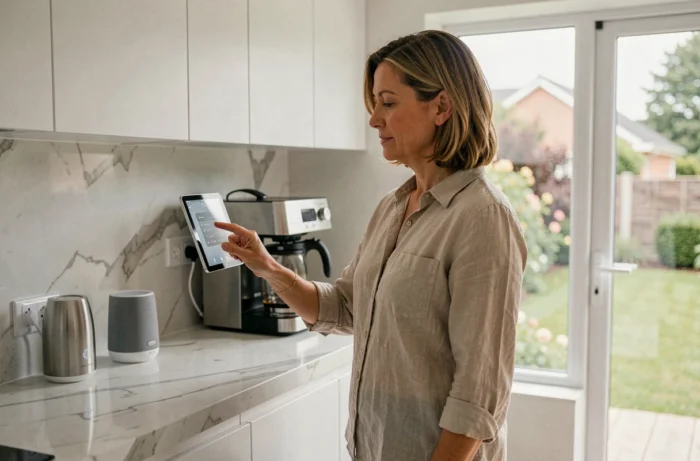
A radiator heating an empty apartment all day, a light left on in the hallway for eight hours, a doubt about the front door while on the way to the office: we’ve all experienced these situations. Home automation and connected objects provide concrete solutions to these daily annoyances, without requiring heavy work or advanced technical skills.
Matter Protocol and Compatibility of Connected Objects: What Really Changes
Before buying any sensor or bulb, we often encounter the same problem: this product works with Alexa but not with HomeKit, another requires a dedicated Zigbee gateway. The Matter protocol was designed to end this fragmentation.
On paper, a Matter-certified device communicates with any compatible ecosystem. In practice, a Matter certification does not guarantee that all functions will be accessible everywhere. The manufacturer must implement the function in the firmware, and the home automation controller must support it.
Sometimes, the local network must also have the required hardware (a Thread router, for example). A Matter thermostat can display the temperature on Google Home but may only offer its advanced programs in the manufacturer’s app.
It is recommended to check three points before purchasing: the Matter version supported by the object, the functions actually exposed to the chosen controller, and the presence of a Thread border router if the product uses this network. Online catalogs like https://www.objets-domotique.fr/ allow for comparing technical specifications and supported protocols for each device.
Connected Thermostat: Regulatory Requirement and Real Heating Savings
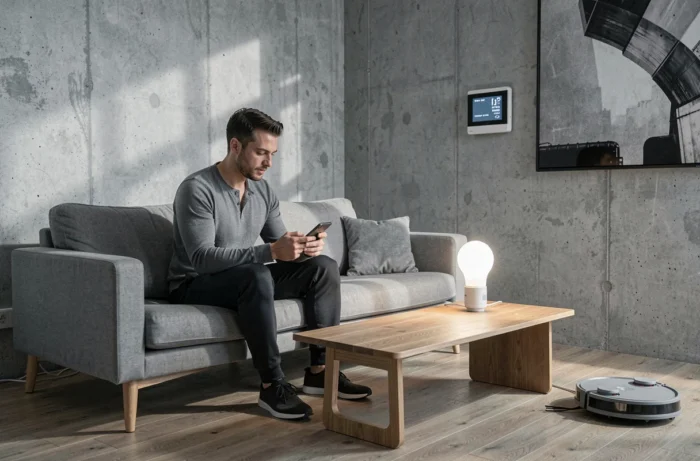
Heating remains the area where home automation has the most measurable effect on a bill. A connected thermostat adjusts the temperature room by room according to occupancy schedules, outdoor weather, and the habits of the occupants.
On the regulatory side, the timeline has shifted in France. The decree of December 26, 2025, postpones the obligation for automatic regulation for existing buildings to January 1, 2030. The constructions concerned from 2027 remain subject to the initial deadline. A useful clarification: the text does not impose a connected thermostat to the Internet, but a programmable regulation, by room or by zone, subject to the exceptions provided.
A connected thermostat goes further than a simple programmer. It learns the heating times of the home, detects open windows through a sudden drop in temperature, and automatically turns off the heating when the last occupant leaves the home. The difference between a basic programmable model and a connected model with learning lies in these automations, which prevent recurring oversights.
Concrete Selection Criteria for a Thermostat
- Compatibility with the existing heating system (boiler, heat pump, electric radiators with pilot wire): not all thermostats manage all types of installations
- Communication protocol: Wi-Fi, Zigbee, Thread, or proprietary. A Thread/Matter model will be more sustainable in the face of ecosystem changes
- Real multizone management: some models display “multizone” but require a thermostatic head per radiator as an extra, which increases the budget
- Integrated presence detection or pairing with a third-party sensor, to turn off the heating without manual intervention
Connected Home Security and European Cyber Resilience Act
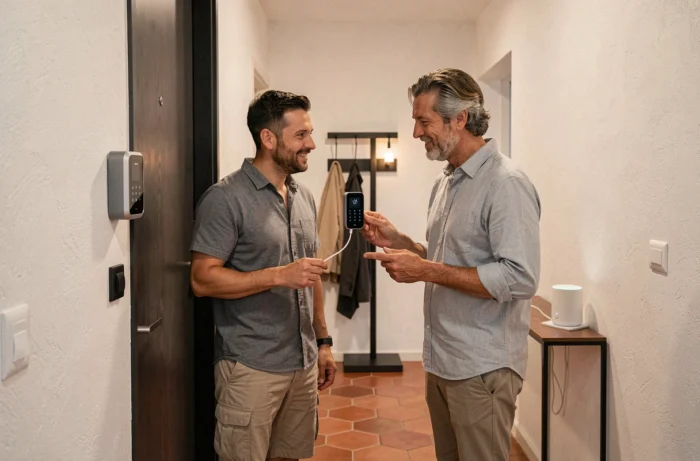
Cameras, smart locks, opening detectors: security is the second main use of the connected home. A Wi-Fi camera is often installed mainly to monitor the entrance, without realizing that each connected object on the home network is a potential entry point for a digital intrusion.
The European Cyber Resilience Act changes the game. According to Face au Risque, the obligations for managing and reporting vulnerabilities will apply from September 11, 2026. Full compliance requirements will concern new products launched on the market from December 11, 2027. In practical terms, manufacturers will need to provide security updates for the entire expected lifespan of the product and actively report vulnerabilities that are being exploited.
Network Security Measures to Apply Upon Installation
Even before discussing regulations, a few actions significantly reduce the attack surface of a home automation installation.
- Create a separate Wi-Fi network (VLAN or guest network from the router) dedicated to connected objects, isolated from the main network where sensitive data (computer, smartphone) transits
- Disable remote access (cloud) on devices that do not need it: a temperature sensor has no reason to be reachable from the outside
- Check that the manufacturer publishes a history of firmware updates: a product without an update for over a year is a warning sign, regardless of its price or brand
Multi-Device Home Automation Scenarios: When Connected Objects Collaborate
The interest of home automation goes beyond the isolated use of each device. A door opening detector coupled with a scenario can simultaneously turn on the entrance lighting, deactivate the alarm, and raise the thermostat to a comfortable temperature. It is the cross-automation between devices that generates the real time savings, not the accumulation of objects controlled one by one from an app.
To build these scenarios, a central controller is needed. Options range from proprietary home automation hubs (Somfy, Fibaro) to open-source solutions like Home Assistant, which runs on a mini PC or Raspberry Pi. The choice depends on the desired degree of customization: a proprietary hub works in a few minutes, while Home Assistant requires a longer configuration time but offers significantly greater flexibility for complex scenarios.
One point varies among households: the number of devices at which a central controller becomes cost-effective compared to application-by-application control. Below four or five connected objects, dedicated apps are sufficient. Beyond that, the multiplication of apps becomes a hindrance, and a central hub simplifies daily management.
Home automation does not require a huge budget or a complete overhaul of the electrical installation. A thermostat, two or three sensors, and a well-thought-out automation scenario are enough to sustainably change the comfort and consumption of a home. The most effective starting point remains to target the most frequent daily annoyance, whether it is heating, lighting, or security, and to address it with a single connected object before gradually expanding the installation.