
External hemorrhoids are among the most common reasons for consultations in proctology, but most affected individuals first attempt a visual self-diagnosis. A lump perceived at the edge of the anus can correspond to several distinct pathologies, and confusing an external hemorrhoid with a fissure, a fistula, or a more concerning lesion can sometimes delay appropriate management. Knowing how to recognize the typical appearance of an external hemorrhoid remains the most useful step before any decision is made.
External hemorrhoidal thrombosis: the most concerning appearance in photos
The majority of image searches related to external hemorrhoids actually concern acute external hemorrhoidal thrombosis. This distinction is rarely clarified in public content, even though it completely changes the visual interpretation.
An uncomplicated external hemorrhoid appears as a soft swelling, flesh-colored or slightly pink, located on the anal edge. It may be barely visible or form a small skin fold (tag) that persists between episodes. Discomfort is moderate: itching, a feeling of heaviness, irritation during bowel movements.
Thrombosis, on the other hand, appears suddenly. The nodule is tense, bluish-purple under the skin, often very painful to the touch. It does not bleed or bleeds little, contrary to what many imagine. This purplish coloration indicates the formation of a clot in the hemorrhoidal vessel. To see real photos of external hemorrhoids, it is essential to keep in mind this difference between the soft form and the thrombosed form, as the two do not warrant the same reaction.
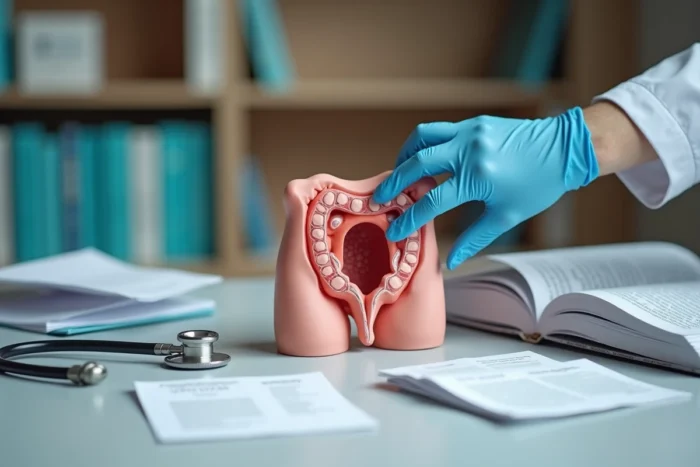
The pain from thrombosis peaks within the first 48 hours, then gradually decreases over a few days. If the clot resolves on its own, it may leave a residual tag, meaning a small excess of skin that does not disappear spontaneously.
What does not look like an external hemorrhoid in photos
Identifying an external hemorrhoid also involves excluding what is not one. Several anal pathologies visually mimic the hemorrhoidal “lump,” with very different consequences if neglected.
- A small opening at the edge of the anus, sometimes accompanied by purulent or yellowish discharge, suggests an anal fistula. The appearance is nothing like a smooth swelling: rather, one observes a hole with oozing.
- A single, linear ulceration, very painful during bowel movements, is more likely to correspond to an anal fissure. The pain is described as a sharp cut, different from the hemorrhoidal heaviness.
- An irregular, hard, non-reducible mass that does not resemble a smooth lump and is accompanied by weight loss or general health deterioration warrants prompt medical advice. Any atypical persistent anal mass should be examined by a doctor.
The most common confusion remains that between a tag and an active hemorrhoid. The tag is a skin residue, painless, that does not swell during episodes. It requires no treatment unless it causes aesthetic or hygienic discomfort.
External hemorrhoid and hemorrhoidal crisis: reading symptoms beyond the image
A photo does not convey pain or the chronology of symptoms. The visual appearance alone is not sufficient to make a reliable diagnosis. Two contextual elements help better interpret what is observed.
The first is the speed of onset. A chronic external hemorrhoid evolves slowly, with phases of irritation and calm. Thrombosis, however, occurs within hours, often after intense physical exertion, a prolonged episode of constipation, or prolonged sitting.
The second is the nature of the bleeding. External hemorrhoids rarely bleed profusely. Bright red bleeding on toilet paper or in the bowl is more indicative of internal hemorrhoids (grade 1 or 2). Dark bleeding mixed with stools completely falls outside the hemorrhoidal framework and requires medical advice.

A typical hemorrhoidal crisis lasts on average two to four days before resolving spontaneously, according to the French National Society of Gastroenterology. The pain is exacerbated by bowel movements, with a sensation of heat and localized heaviness.
Sports, exertion, and external hemorrhoids: an underestimated visual factor
Recent proctological literature is increasingly focusing on the impact of certain sports activities on hemorrhoidal complications. Sports that involve an increase in abdominal pressure (weightlifting, heavy weight training, prolonged cycling) promote congestion of the hemorrhoidal plexus.
Specifically, a person who regularly engages in heavy lifting may notice swelling at the anal edge after exertion, sometimes confused with thrombosis when it is merely a transient congestion. The appearance is that of a soft swelling, slightly bluish, which regresses within a few hours without treatment.
However, the repetition of these congestive episodes can lead to the formation of permanent tags or true thromboses in predisposed individuals. Field reports vary on the threshold of exercise intensity at which the risk truly increases, and there is no universal numerical recommendation on this point.
When to consult a doctor for an external hemorrhoid
Visual self-diagnosis has its limits. Even with reference photos, several situations require a clinical examination by a professional.
- Severe pain that does not decrease after 48 to 72 hours suggests thrombosis that may potentially require incision under local anesthesia.
- Recurrent bleeding, even minimal, that persists beyond a few days warrants exploration by anoscopy to rule out associated internal pathology.
- Any rapid change in appearance (induration, ulceration, unusual discharge) falls outside the classic hemorrhoidal framework.
- After age 50, any anal bleeding requires medical advice, even if the external appearance suggests benign hemorrhoids.
The diagnosis relies on inspection and anoscopy, a non-traumatic examination performed in the office. It allows differentiation between internal and external hemorrhoids and grading their severity, which no photo can accomplish from a distance. The image remains a tool for orientation, not a substitute for clinical examination.