
Installing a motorized sectional garage door requires skills in masonry, electricity, and mechanics. Each phase of the installation, from checking the opening to connecting the motor, determines the reliability and safety of the system in the long term. This guide analyzes the technical parameters that separate a successful installation from one that needs to be redone.
Motorized sectional door: comparison of installation configurations
The choice between a ceiling-mounted and a side-mounted configuration does not depend solely on aesthetic preference. Several structural parameters guide the decision well before purchasing the panels and the motor.
| Criterion | Ceiling-mounted | Side-mounted |
|---|---|---|
| Required lintel height | Sufficient lintel drop to accommodate horizontal tracks and the motor trolley | Reduced drop, tracks fixed to a side wall |
| Ceiling space | Horizontal tracks throughout the depth of the garage | Ceiling completely free |
| Motorization compatibility | Motor mounted on the ceiling with rail and trolley | Motor integrated into the side axis |
| Suitable for garages with high storage | No (conflict with high shelves) | Yes |
| Installation complexity | Standard, abundant documentation | More technical, precise lateral adjustment |
The majority of residential installations adopt the ceiling-mounted configuration, as manufacturer documentation and commercial kits are tailored for this setup. However, a garage with a ceiling cluttered by ventilation ducts or a low floor often necessitates a side-mounted configuration.
Before ordering, measuring the lintel drop and the available ceiling depth is the first step to take. A difference of a few centimeters can make a standard kit incompatible and require costly adjustments to the tracks and uprights.
To delve deeper into each phase of the project, the installation of a motorized sectional garage door details the complete operational sequence, from pre-assembly to commissioning.
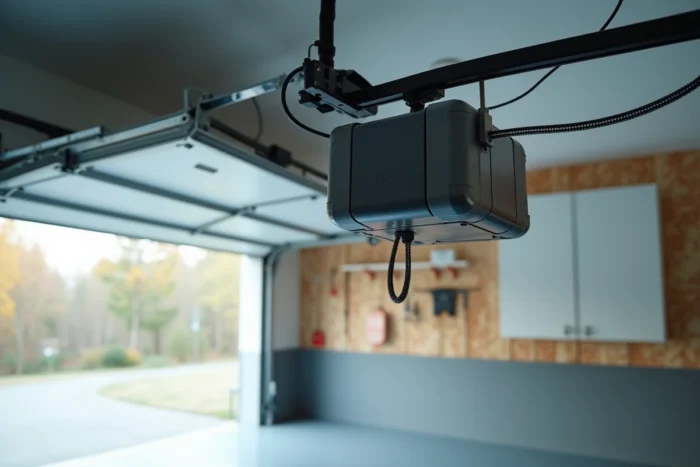
Compliance with the NF EN 12453 standard and motor safety
The NF EN 12453 standard regulates door and gate automation by imposing obstacle detection. The motor must stop and then reverse the door’s movement when it encounters abnormal resistance. Ignoring this requirement exposes individuals to the risk of being trapped and invalidates the installation’s compliance.
On recent models, this detection relies on monitoring the motor torque coupled with photoelectric cells or a safety edge. Adjusting the detection sensitivity is among the final steps of installation, and a poorly calibrated threshold renders the device either ineffective or prone to false triggers.
Safety parachute and spring break
Motorized sectional doors increasingly incorporate a fall arrest parachute integrated into the springs. This mechanism locks the door in position if a spring breaks, preventing a sudden drop of several dozen kilos onto a vehicle or person.
- Check for the presence of the parachute in the kit before assembly, as some entry-level models do not include it as standard.
- Test the device by simulating a release of tension on the spring, following the manufacturer’s procedure.
- Visually inspect the condition of the springs and parachute at least once a year to prevent wear.
These two safety elements, obstacle detection and parachute, constitute the minimal foundation of a compliant installation. A motorization without obstacle detection is not compliant with regulations and holds the installer liable.
Adjustment of tracks and motor trolley: often overlooked checkpoints
The installation of vertical and horizontal tracks concentrates the majority of errors on a sectional door project. A misalignment of just a few millimeters on the vertical uprights results in asymmetric panel rubbing, premature wear of seals, and abnormal operating noise.
Upright plumb and level of horizontal tracks
A laser level is a better alternative to a bubble level for checking the plumb of the uprights over the entire height of the opening. The horizontal tracks should have a slight downward slope towards the back of the garage, calibrated according to the manufacturer’s specifications, so that the door rests correctly in the open position.
The motor trolley, mounted on the central horizontal rail, must be aligned with the door’s axis. A lateral offset causes uneven pulling, putting more strain on one side of the door and potentially deforming the panels over multiple opening cycles.
Ceiling attachment and support type
The strength of the ceiling attachment directly depends on the encountered material. A solid concrete ceiling accepts expansion metal anchors. A hollow block or drywall ceiling requires reinforcements (metal or wooden crossbars) to distribute the load of the rail and motor.
- Identify the type of ceiling before installation: solid concrete, hollow blocks, steel deck, drywall on a frame.
- Adapt the type of anchor to the support: chemical anchor for hollow materials, hammer-in anchor for solid concrete.
- Test the hold of each attachment point by applying manual tension before suspending the rail.
A poorly fixed rail on the ceiling vibrates with each cycle and eventually pulls out its anchors. This defect may only manifest after several weeks of use.

Electrical connection and commissioning of the motor
The motor of a sectional door connects to a dedicated electrical line, protected by a circuit breaker suitable for the device’s power. Sharing the circuit with existing lighting or outlets creates a risk of false triggering and complicates diagnostics in case of failure.
The connection of photoelectric cells and the wall switch is done in low voltage, according to the diagram provided by the manufacturer. Each wire must be labeled and tightened on the motor terminal block before the first power-up. A reversed connection on the cells renders the obstacle detection inoperative, which nullifies compliance with the NF EN 12453 standard.
The commissioning includes learning the travel limits: the motor records the high and low positions of the door during several manual cycles. An imprecise adjustment of the travel limits either crushes the bottom seal against the ground or leaves a visible gap under the last panel.
The last point to check before considering the installation complete is the manual disengagement. In case of a power outage, a handle or cord allows the trolley to be detached from the rail to operate the door manually. Ensuring that this mechanism works without excessive effort guarantees access to the garage under all circumstances.