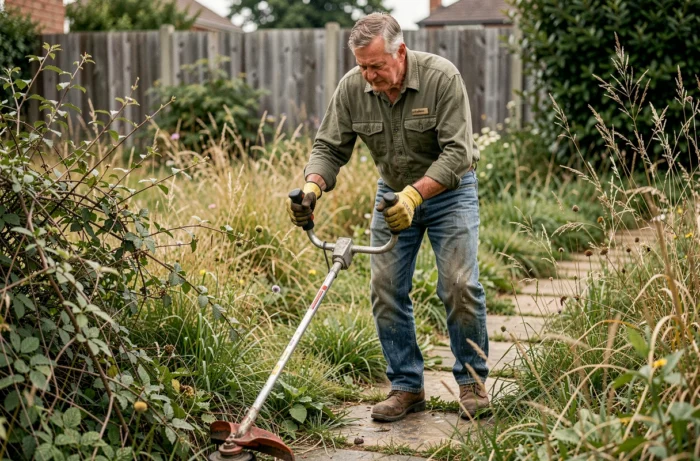
A brushcutter is a motorized cutting tool designed to eliminate dense vegetation where a lawnmower cannot reach: slopes, edges, brambles, tall grasses. Choosing the best brushcutter for your garden involves considering three technical parameters: the type of motorization, the cutting system, and the configuration of the terrain to be maintained.
Nylon line, blade, or disc: the cutting system determines everything else
Even before comparing engines, the choice of cutting system determines what the machine can actually do. A nylon line is suitable for soft grasses and edge finishing. It wears out quickly on woody stems and will never tackle thick brambles.
A two or three-tooth blade tackles semi-woody vegetation: seed-bearing nettles, dense ferns, young shrub regrowth. For heavy clearing (established brambles, coppice shoots), a steel-toothed disc becomes the only effective option.
A common pitfall is buying a powerful brushcutter equipped only with a nylon line, only to find that it struggles with tough vegetation. Check that the model accepts multiple types of interchangeable cutting heads. The catalogs available at debroussailleuse-warrior.com allow for compatibility comparisons between cutting heads and machines.
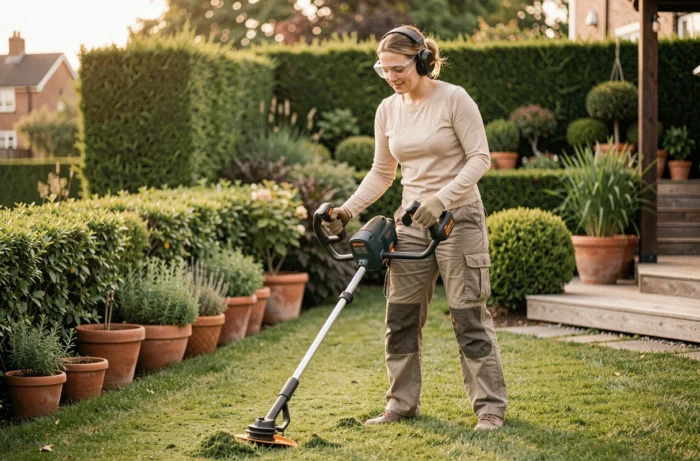
Gas, battery, or corded: choose based on area and noise constraints
The motorization remains the criterion that most buyers examine first, but it should come after the cutting system. Each power source imposes different compromises.
Gas brushcutter
A gas engine (two-stroke or four-stroke) offers the greatest autonomy and the highest power. It is the logical choice for large areas or dense wastelands. The downside: weight, noise, and mechanical maintenance (spark plug, air filter, oil-gas mixture for two-stroke).
A four-stroke engine consumes less and produces less vibration than a two-stroke of comparable power. It is more expensive to purchase and weighs more.
Battery brushcutter
Battery models have made significant progress in recent years. They are suitable for modest-sized gardens where the working time per session remains limited. The absence of a cable and instant starting are real practical advantages.
A point to monitor now: European regulations will require, starting February 2027, that integrated portable batteries be removable and replaceable by the user with common tools. When purchasing, prioritize a model whose battery is already easy to remove, so you don’t end up with a device that is obsolete in terms of regulations.
Corded electric brushcutter
Lightweight and inexpensive, the corded brushcutter is limited to small gardens close to a power outlet. The cable restricts the range of action and becomes a real nuisance on uneven terrain or planted with shrubs.
Handle or handlebars: ergonomics affects the sustainable working duration
This point is often overlooked in buying guides, yet it directly affects muscle fatigue and the precision of the action.
- The loop handle (or simple handle) offers good maneuverability in tight spaces, slopes, and cluttered areas. It is suitable for precision work and short sessions.
- The handlebars (double T or U handle) distribute the effort across both arms and the back. On open, flat surfaces, it allows for mowing for much longer periods without lower back pain.
- An appropriate carrying harness (a harness rather than a simple strap) makes as much difference as the choice of handlebars. On a gas brushcutter, the weight often exceeds several kilograms: without a proper harness, fatigue sets in within minutes.
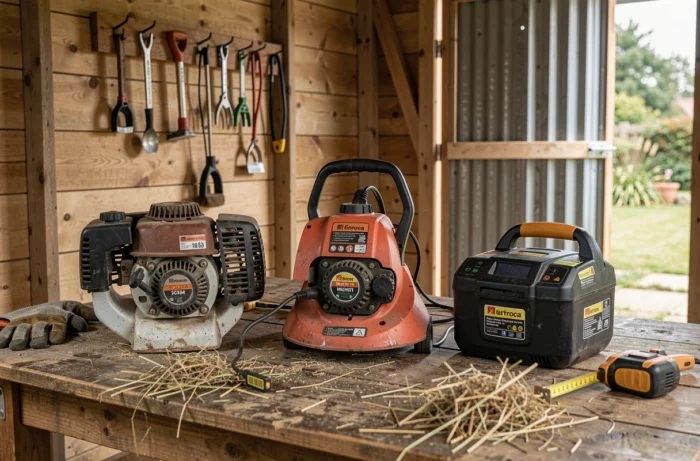
Adapting the brushcutter to the actual terrain configuration
Product sheets rarely indicate in what context the machine excels. Two gardens of the same size may require very different machines.
A flat area with flowerbed edges and a bit of tall grass at the back of the plot can be managed with a trimmer or a lightweight battery brushcutter equipped with a nylon line. There’s no need to oversize.
A sloped area with brambles and shrub regrowth requires a gas brushcutter with a disc, supported by a harness of the type harness. The power of the engine matters less than the ability to maintain stable torque in resistant vegetation.
For mixed terrains (one part maintained, a back garden in wasteland), a versatile model accepting both nylon line and a three-tooth blade covers most situations. Ensure that switching from one cutting tool to another does not require specialized tools.
Maintenance and lifespan of a brushcutter: what makes the difference
The reliability of a brushcutter depends as much on its maintenance as on its initial quality. On a gas model, cleaning the air filter after each use and periodically replacing the spark plug is enough to extend its lifespan by several seasons.
On a battery model, managing charge cycles is more important. Storing a completely discharged lithium-ion battery for several months irreversibly degrades its cells. Recharge it partially before winter storage.
- Gas: drain the tank at the end of the season, clean the filter, check the spark plug
- Battery: store the battery between 40% and 60% charge, at room temperature, outside the device
- All models: check the condition of the protective cover, replace the nylon line or sharpen the blade as soon as they show signs of wear
The availability of spare parts (cutting heads, covers, harnesses) remains an underestimated purchasing criterion. A major brand model like Stihl or Husqvarna guarantees a distribution network for parts, whereas some entry-level brands cease production of replacements after a few years.
The final choice boils down to three concrete questions: what vegetation to cut, on what surface, and for how long per session. Honestly answering these three points avoids both oversizing and the too-weak machine that will end up at the back of the garage.