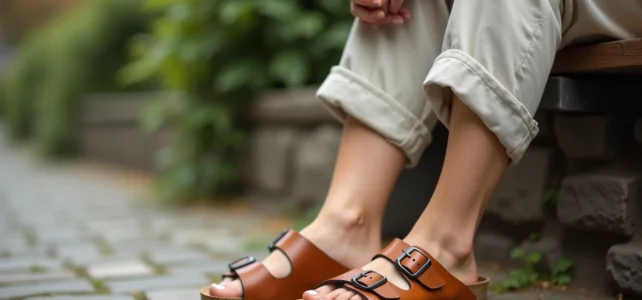
Scholl and Birkenstock share a promise of orthopedic comfort, but their sandals are based on distinct technical designs. The anatomical footbed of each brand does not support the foot in the same way, and the materials used point towards different uses. Comparing these two references requires going beyond mere appearance to examine the internal structure, durability, and the type of foot each model is aimed at.
Stiffness of the sole and foot support: what really separates Scholl from Birkenstock
The technical foundation of a sandal is its sole. Birkenstock uses a footbed made of cork and natural latex, molded to fit the arch of the foot along its entire length. This construction provides marked stiffness that keeps the foot in a stable position, even on uneven surfaces.
Scholl takes a different approach. Its flagship models, like the Pescura mules, incorporate a sole made of wood or a softer composite material, designed to absorb shocks when walking on flat surfaces. Scholl prioritizes immediate cushioning over structural support, which explains why the brand has long been associated with professionals who stand all day (nurses, salespeople).
A test broadcast by the German channel NDR in 2024 compared Birkenstock-type sandals to the original and concluded that the higher stiffness of the Birkenstock sole makes it more of an outdoor shoe than an indoor slipper, in terms of support and wear. This distinction is rarely addressed in comparisons, even though it conditions the choice based on the primary use.
For those looking for comprehensive reviews of Scholl or Birkenstock before making a decision, this difference in stiffness remains the first criterion to consider.

Materials and durability of sandals: leather, cork, and resins against wear
The choice of materials determines the longevity of a sandal as much as its comfort. Birkenstock relies on a combination of natural cork, leather (or Birko-Flor, its proprietary synthetic material), and EVA outsoles. The cork gradually compresses to adapt to the shape of the foot, improving comfort over the weeks.
Scholl uses more resins, treated wood, and synthetic leather depending on the ranges. Entry-level models favor less expensive materials, positioning the brand at a more accessible price point. Birkenstock aims for durability over several seasons, while Scholl aims for immediate accessibility.
In practice, Birkenstock soles can be resoled, extending their lifespan. This option does not exist for most Scholl models, whose monobloc construction makes sole replacement impossible. For a sustainable purchase, this factor weighs into the calculation of the actual cost.
Scholl or Birkenstock sandals: tailoring the choice to foot type
Flat feet, high arches, and standard feet do not react the same way to an anatomical sole. Birkenstock offers pronounced arch support that particularly suits feet needing lateral support and arch support. The Arizona model, a brand reference, illustrates this logic with its two adjustable straps and deep footbed.
Scholl, whose heritage dates back to the podiatric medicine of William Mathias Scholl in the early 20th century, designs its soles to relieve pain associated with prolonged standing. Models with solid wood soles (like Pescura) offer a slight rocking effect that engages the calf muscles, a feature appreciated for blood circulation.
Here are the criteria that guide the choice based on foot profile:
- Flat or unstable foot: Birkenstock, thanks to the deep bowl of the cork footbed that stabilizes the heel and supports the arch
- Sensitive foot to shocks (plantar fasciitis, painful heel): Scholl, whose soft cushioning reduces pressure on the heel with each step
- Extended outdoor use (walking, traveling): Birkenstock, whose rigid sole better supports varied terrains and repeated wear
- Indoor use or static professional use: Scholl, with lightweight models and comfort felt from the first wear
Price and positioning: two distinct pricing strategies
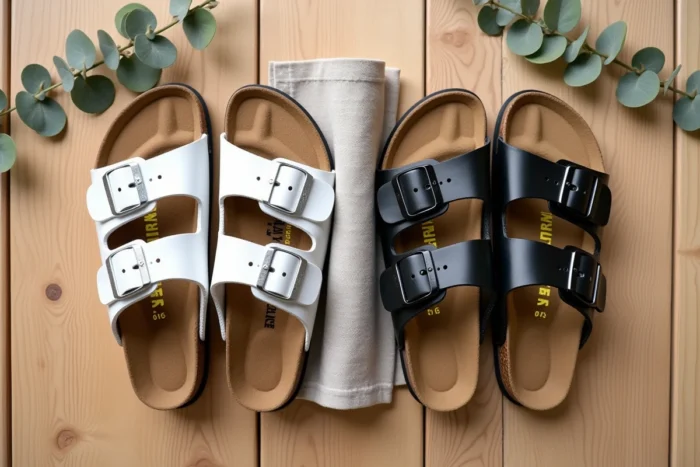
Birkenstock positions itself in the mid-high segment. The Arizona model in natural leather significantly exceeds the price of a classic Scholl mule. This price reflects the cost of materials (natural cork, full-grain leather) and the possibility of resoling.
Scholl covers a broader range, with accessible entry-level models and fashion collaborations that push some prices higher. The brand has notably collaborated with houses like Céline, occasionally repositioning its mules as fashion accessories. Price alone is not enough to distinguish the two brands: it is necessary to relate the price to the expected lifespan and intended use.
A Birkenstock worn over several seasons, resoled once, can sometimes be cheaper to wear than a Scholl replaced every year. This logic of cost per use remains the most reliable calculation for comparing the two.
Fashion and style of sandals: two inverse trajectories
Birkenstock has undergone a fashion turnaround in recent years, transitioning from a functional sandal status to an accessory worn by luxury houses. The Boston model, originally designed as an indoor clog, is now featured in streetwear collections and fashion shows.
Scholl has taken the opposite path. Long confined to the paramedical sector, the brand is returning to fashion with its wooden mules, which have become a symbol of retro style. The Pescura mule is experiencing a resurgence of interest fueled by Y2K trends and the return of 2000s accessories.
Both brands are converging towards fashion through opposite paths: Birkenstock is moving upscale, while Scholl is playing the accessible revival card. The choice depends as much on the wardrobe as on podiatric needs, and mixing the two criteria often leads to the best decision.