
The Faroe Islands apply a local land law distinct from continental Danish law. This peculiarity radically changes the approach to real estate purchases for foreigners, including European citizens accustomed to the rules of the single market. Buying a house in the Faroe Islands means navigating between two overlapping legal regimes: that of Denmark for residency and that of the archipelago for property ownership.
Faroe Island Land Law and Restrictions on Purchases for Non-Residents
The technical point that most guides overlook: the right to reside in the Faroe Islands does not automatically grant any right to land ownership. A French citizen can stay freely for up to three months, then apply for a residence permit from the Danish immigration service responsible for the Faroe Islands. This migration framework, aligned with the Danish system, does not extend to land ownership.
Property rules fall under local Faroese law, which requires specific checks before any transaction involving a foreign buyer. In recent years, we have observed a strengthening of these controls, reflecting a political will to preserve the island’s land heritage.
To explore the possibilities of real estate purchases in the Faroe Islands, one must first verify eligibility according to this local regulation, distinct from anything a European buyer knows on the continent.
Dissociation of Immigration and Property: A Common Trap
A potential buyer who obtains their Danish residence permit for the Faroe Islands may legitimately think that the land is free. This shortcut is false. The processing of the property file goes through the Faroese authorities, not Copenhagen.
The concrete risk: incurring due diligence costs, hiring a local notary, only to discover that the acquisition is blocked by a land clause specific to the municipality concerned. We recommend validating land eligibility before any purchase offer.

Real Estate Market in the Faroe Islands: Prices, Supply, and Ground Reality
The Faroese real estate market is structurally narrow. The archipelago has fewer than 55,000 inhabitants spread across 18 islands, some of which have only a few dozen residents. The supply of properties for sale remains very limited, with an annual transaction volume incomparable to a continental market.
Tórshavn concentrates the majority of available properties. Rents in the city center range between 8,000 and 10,000 DKK for a one-bedroom apartment, and between 12,000 and 15,000 DKK for three bedrooms. The peripheral neighborhoods of Hoyvík and Argir show prices 10 to 15% lower. These rental data give an indication of the purchase price level, which is proportionately high for an archipelago of this size.
Klaksvík, the second city, offers a more accessible market but with an even smaller volume of properties. Rural areas like Runavík or Sørvágar occasionally present opportunities, often traditional houses requiring significant renovations.
Absence of a Centralized Real Estate Aggregator
Unlike continental Denmark, where platforms like Boligsiden centralize listings, the Faroe Islands do not have a single reliable real estate portal. Transactions often go through:
- Local agencies based in Tórshavn, which manage almost all sales mandates on the archipelago
- Word of mouth and community networks, especially in villages where properties change hands without public listings
- International platforms (Realting, for example) that list a few Faroese properties, but with frequent discrepancies between the listing and actual availability
This market opacity significantly complicates prospecting for a foreign buyer who does not have a local network.
Bank Financing in the Faroe Islands for a Foreign Buyer
Obtaining a Faroese mortgage without established residency on the archipelago is extremely difficult. Local banks apply solvency criteria based on Faroese employment and income. A foreign buyer who does not work locally will, in the vast majority of cases, need to finance their acquisition through personal funds or via a loan taken out in their home country.
The Faroese banking system remains distinct from the Danish banking network. Major Danish banks do not offer mortgage products for properties located in the Faroe Islands. One must contact local banks directly, which evaluate each case individually.
Taxation and Additional Costs
Faroese property taxation follows its own scales, distinct from those of Denmark. Transfer fees, property taxes, and any potential capital gains fall under local tax law. A French buyer must also check the existence of an applicable bilateral tax treaty, as the Faroe Islands are not systematically covered by agreements signed between France and Denmark.
Buying a House in the Faroe Islands: Preliminary Checks Not to Be Overlooked
The buying process in the Faroe Islands involves checks that have no direct equivalent in France. Before signing anything, we recommend validating several points:
- The buyer’s land eligibility with the local Faroese authorities, not just with the Danish immigration services
- The legal status of the land: some properties are located on communal land or subject to traditional collective usage rights
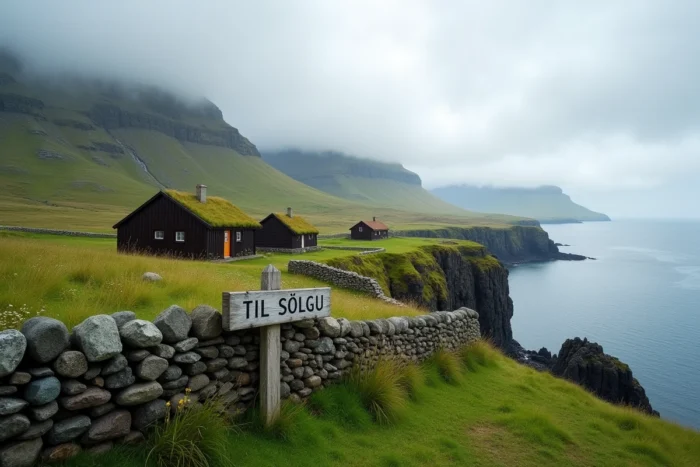
- The structural condition of the building, particularly for traditional houses with green roofs, which require specific local maintenance expertise
- The viability of connections (water, electricity, road network) in the most isolated localities
A mandate entrusted to a Faroese lawyer specializing in local land law is the only reliable guarantee against administrative blockages during the transaction. Continental Danish notaries do not master the specifics of the Faroese regime.
The archipelago remains a niche market where patience and local networks matter as much as the budget. Buying in the Faroe Islands is more of a life project than a traditional investment, and regulatory constraints naturally filter out buyers who do not have this approach.