
Choosing a sock size for a shoe size 42 involves deciding between two size ranges that most brands offer. Size 42 is exactly at the boundary between the lower range (often labeled 39-42) and the upper range (43-46). This positioning creates measurable comfort discrepancies depending on foot morphology, material, and intended use.
Shoe Size 42 and Size Ranges: The Correspondence Table by Category
Sock manufacturers do not offer a single size. They group several sizes within the same range. For a size 42, two ranges coexist depending on the brands and lines.
| Size Range | Covered Sizes | Foot Length (cm) | Suitable for 42 |
|---|---|---|---|
| 39-42 | 39, 40, 41, 42 | approximately 24.5 to 27 | Yes, but at the upper limit |
| 43-46 | 43, 44, 45, 46 | approximately 27 to 29.5 | Possible if foot is wide or has a high instep |
| One Size 36-42 | 36 to 42 | approximately 22.5 to 27 | Often too tight for a 42 |
The 39-42 range places the size 42 foot at the very top of the range. The knit is stretched to its maximum in length and over the instep. In contrast, the 43-46 range allows for more margin, with a risk of excess fabric at the toes if the foot is slender.
To delve deeper into the correspondences and specifics of this size, a size 42 sock guide on Style Papers details the variations according to French and international brands.
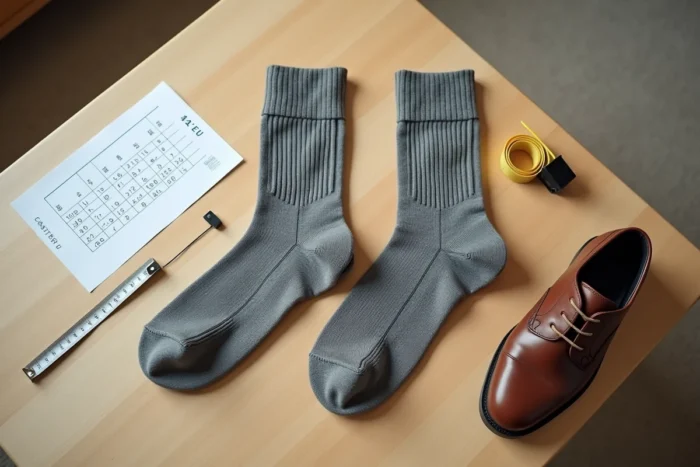
One Size 36-42: Why Size 42 Suffers at the End of the Range
Socks labeled “one size 36-42” dominate the entry-level and fancy models. This range of six sizes seems practical, but it poses a concrete problem for a size 42 foot.
Beyond size 42, the sock compresses the foot and fragile threads (lurex, glitter, very tight patterns) can break under tension. A size 42 foot is already at the upper limit of this range. Comfort then depends on morphology: a long and narrow foot fares better than a wide foot with a pronounced instep.
Signs of a sock that is too tight are easy to spot:
- The ankle elastic slips down while walking because the fabric is pulled toward the front of the foot and no longer stays in place
- The toe seam ends up on the top of the foot instead of at the tip, creating friction in the shoe
- The anatomical heel (the reinforced part) rides up toward the ankle instead of staying in place
For a size 42, opting for the dedicated 39-42 range rather than the one size 36-42 reduces this risk. The difference lies in the construction: a 39-42 range starts from a larger template, while a one size 36-42 starts from a median template (around size 39) stretched in both directions.
Material and Thickness of Socks: The Effect on Size Choice for Size 42
The material alters the behavior of the sock when stretched. This factor weighs as much as the size range displayed on the label.
Thin Cotton or Synthetic Socks
Fibers of cotton blended with elastane offer good elasticity. For a size 42, the 39-42 range works well with this type of thin sock. Blended cotton returns to its shape after washing, which limits gradual deformation.
Thick Wool Socks for Hiking
Hiking socks made of merino wool or technical blends have a denser knit. The thickness reduces the available volume in the shoe. For a size 42 foot, two constraints accumulate: the sock must cover the length of the foot without compression, and the thickness of the fabric must remain compatible with the shoe.
With thick hiking socks, a size 42 often benefits from testing the 43-46 range. The excess length at the toes remains minimal and is compensated by the volume of the knit, whereas the compression of a thick 39-42 in a hiking shoe promotes blisters and friction areas.
Sports Socks with Support Zones
Technical models with differentiated compression zones (arch, ankle, toes) are designed to fit the foot precisely. These socks often segment sizes more finely. For a size 42, staying within the range that includes this size without placing it at the upper end provides better support for the reinforced areas.
Measuring Your Foot to Confirm the Suitable Sock Size for 42
Shoe size alone is not always sufficient. A size 42 from one manufacturer may correspond to a foot of 26.5 cm, while another calibrates its 42 to 27 cm. Direct measurement of the foot clears up this ambiguity.
Place your foot flat on a sheet of paper, draw a line at the heel and another at the tip of the longest toe. The distance between the two lines gives the actual length. Then compare this measurement to the target brand’s chart.
- A foot measuring less than 26.5 cm should definitely go for the 39-42 range
- A foot of 27 cm or more, or a wide foot, should switch to the 42-46 range for thicker materials
- The width of the foot and the height of the instep matter as much as the length for actual comfort in the sock
Measuring the foot at the end of the day gives a more reliable result, as the foot slightly swells over the hours. This variation can represent half a size, which is enough to shift the choice between two size ranges.
The size choice for a 42 boils down to one main variable: the position of the foot within the range. A size 42 placed at the upper limit of a range that is too wide will always fit worse than a size 42 in the middle of the range. Checking the actual length of the foot and considering the thickness of the sock allows for precise decision-making between the two available ranges.