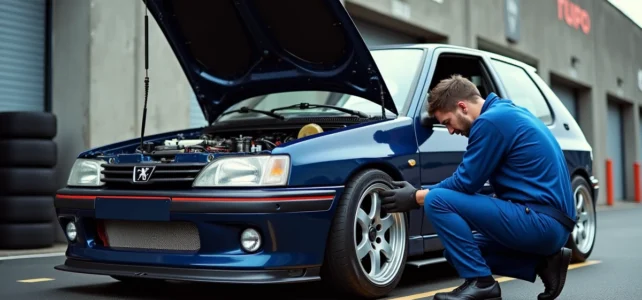
The Peugeot 306 Maxi remains an icon of French rallying. Its wide body kit, muscular wheel arches, and aggressive silhouette have inspired generations of enthusiasts. When the idea of driving a 306 on the track arises, the temptation for a maxi kit comes quickly. However, the real question must be asked: does this kit provide a real advantage on the track, or is it primarily about aesthetics?
Track Width and Handling on Circuit: What a Maxi Kit Really Changes
A maxi body kit visually widens the car. The flared fenders allow for wider wheels and thus tires with a larger section. On paper, this is a direct advantage for cornering performance.
In practice, widening the track without revising the complete geometry degrades handling. A simple fiberglass or polyurethane body kit does not modify the suspension arms, anchor points, or the front axle’s kinematics. Fitting wider tires on original ball joints and links creates an additional lever arm that prematurely wears out bearings and bushings.
Have you noticed that an original 306 GTI or S16 already performs very well on the track with good dampers? The true 306 Maxi from Peugeot Sport had a completely specific running gear designed around its wider track. An aftermarket body kit does not replicate this mechanical coherence.
To delve deeper into this question and discover concrete feedback from amateur drivers, you can visit the Passion Auto Méca website which discusses the topic in detail.
Budget for a 306 Maxi Kit vs. Chassis Preparation: Where to Invest for the Track
Why is this choice so crucial? Because the budget is not extensible, and every euro spent on the body is a euro taken away from the mechanics.
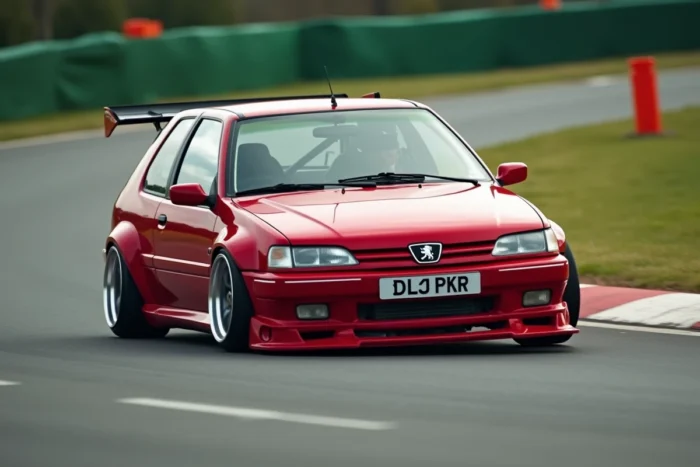
A complete maxi body kit (front and rear fenders, bumpers, side skirts, spoiler) represents a significant investment. You must also add surface preparation, painting, fitting of parts, and sometimes modification of fixings. The total cost of installation often exceeds that of the kit itself.
With the same budget, a track-oriented preparation yields measurable results on the stopwatch:
- Adjustable coilovers for compression and rebound, with reinforced top mounts suitable for the 306
- Enhanced braking: larger diameter ventilated discs, high-temperature pads, aviation hoses, and high boiling point fluid
- Adjustable rear anti-roll bar and polyurethane rear suspension bushings to stabilize behavior under load
- Safety cage (mandatory on most French circuits during open days), harness, and homologated bucket seat
A well-prepared chassis on an original body gains several seconds per lap compared to a car dressed in a maxi kit but running on stock suspensions and brakes.
Value and Traceability of 306 Maxi: A Market That Complicates Replicas
The value of genuine 306 Maxi produced by Peugeot Sport has significantly increased in recent years. The price differences between a documented factory car and a replica based on a GTI can, according to market observations, range from simple to triple, or even more, as soon as the traceability (chassis and Peugeot Sport documentation) is uncertain.
This increase in value has a direct consequence for track enthusiasts. A maxi replica does not benefit from any added value upon resale if it is not clearly identified and documented. The body investment then becomes purely a sunk cost, raising questions about its profitability for exclusive track use.
The market has become very attentive to approximate builds. A maxi kit mounted on an XS or XT base without serious mechanical conversion loses all credibility with informed buyers. If your main goal is enjoyment on the track, that money would be better spent on mechanical preparation.
Road Homologation and Regulatory Constraints of the Wide Body Kit
A maxi kit modifies the overall dimensions of the vehicle. In France, any modification to the width or ground clearance requires an update of the registration document through a single vehicle approval procedure (RTI). Without this process, the vehicle is in violation and the insurance may refuse any compensation in case of an accident.

For strictly track use, this constraint disappears: on private tracks, technical control and registration documents do not apply. However, the vehicle must be transported on a trailer, which adds logistical costs to each outing.
If you want to maintain mixed use (road and track), the maxi kit imposes a double constraint: the administrative homologation procedure and the additional insurance cost related to the modification. A 306 in original body with a clean mechanical preparation completely avoids this problem.
306 on Track Without a Maxi Kit: What Really Makes the Difference on the Stopwatch
The driver progresses faster than the car. On an amateur track day, the gap between two drivers of different skill levels in the same 306 S16 far exceeds what any body modification could provide.
The priority for improving on the track remains driver training, adjusting the driving position, and understanding racing lines. A well-maintained 306 GTI or S16, equipped with suitable dampers and serious braking, is a fearsomely effective track car in the amateur category.
The maxi kit makes sense in a specific context: a faithful reconstruction for historical or aesthetic purposes. To drive fast and safely on the track, it offers nothing that mechanics and driving skills cannot provide at a lower cost. Save the body budget for tires, pads, and driving courses.