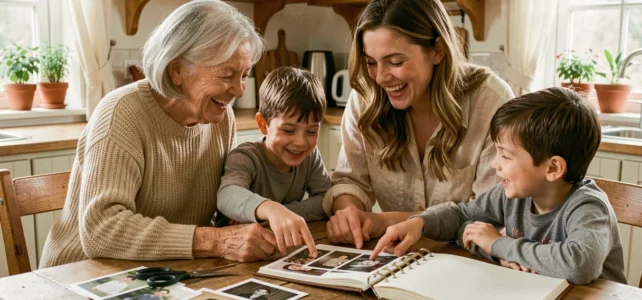
Family photos accumulate by the hundreds in our phones, organized by date, rarely revisited. Transforming these files into personalized photo albums gives them a physical existence, one that can be flipped through and shared. However, it is essential to go beyond simple chronological sorting to create an object that every family member will want to reopen.
Why a physical photo album strengthens family bonds
Have you ever noticed that a child can be captivated for long minutes by an album placed on a coffee table? This is not trivial. Research conducted by Tulane University, Emory University, and the University of Manchester shows that children who regularly see their family photos feel more valued and secure.
The album acts as a storytelling medium. By turning the pages with a parent or grandparent, the child hears the story of their family, situates their place in a lineage, and understands the challenges overcome. This process nurtures their identity formation and emotional resilience.
This return to the printed object goes beyond nostalgia. A show aired on Rythme FM Montreal in August 2026 highlighted that physical photo albums fascinate the younger generation, in response to the constant flow of digital content. The album offers a stable anchor in the home, where scrolling is inherently ephemeral. To explore formats suitable for this type of creation, you will find options on https://www.joliefamily.fr/ that allow you to design an album structured around your own memories.

Personalized photo album: three creative angles that go beyond chronological sorting
Most albums follow a temporal thread: February vacations, March birthdays, December Christmas. The result resembles an illustrated calendar. Three alternative approaches give a whole new dimension to your family memories.
The album by shared rituals
Every family has its habits without always measuring their photographic value. Sunday morning coffee, Wednesday walks, holiday meal preparations. An album built around these rituals tells the personality of a family, not just its dates.
Specifically, group on a double page all the photos related to the same ritual, taken over several months or years. The effect of repetition, with children growing from one image to the next, creates a visual narrative that chronological sorting does not produce.
The album with multiple voices
Rather than entrusting the creation to a single person, each family member chooses their favorite photos and writes a short text to accompany them. A six-year-old child does not remember the same moments as a teenager or a grandparent.
Crossing perspectives on the same event gives the album a rare narrative depth. The birthday party seen by the one who blew out the candles, by the one who prepared the cake, by the cousin filming in the background: three versions, three pages, three different emotions.
The album of a place, not a date
Do you return every summer to the same vacation home, or every Christmas to the same grandparents? Gather all the photos taken in this unique place, regardless of the year. The place becomes the narrative thread, and the passage of time is read in the faces, the garden trees, the paint on the shutters.
Choosing paper and format: what makes a family photo album last
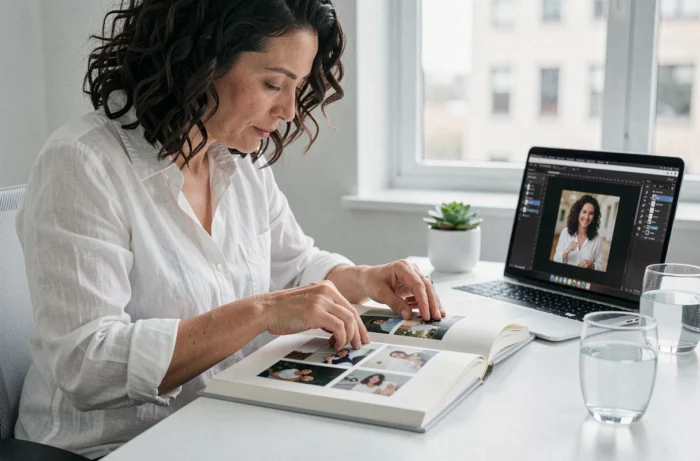
An album flipped through by children’s hands must be durable. The choice of material is as important as the selection of images.
- The paper weight determines durability. A sufficiently dense paper (like cardstock) withstands repeated handling without bending or tearing. Thin paper is suitable for a personal portfolio, not for a family book.
- A matte finish reduces glare and fingerprints, making browsing more pleasant, especially for young children. A glossy or satin finish enhances vibrant colors but marks more quickly.
- The square format works well for thematic albums (rituals, places) because it imposes a centered layout, less linear than landscape format. The landscape A4 format remains the most readable for double pages with text.
A often overlooked point: the binding. A lay-flat binding allows the book to open to 180 degrees without a crease in the center of the double page. Panoramic photos or group portraits thus retain their readability.
Integrating handwritten elements and tangible memories into a personalized album
The pages of an album are not limited to photos. Including physical elements transforms the book into a sensory object.
A scanned child’s drawing printed full page, a park entrance ticket, a little note scribbled on a corner of a tablecloth: these fragments add a layer of memory that the photo alone does not carry. An album that mixes images and handwritten traces becomes a heritage object, not just a simple bound print.
For messages, prefer handwriting over digital typography. The handwriting of a five-year-old, read ten years later, produces an emotion that no font can replicate. Some printing services allow you to directly integrate a scan of handwritten text into the layout.
- Scan drawings and little notes at a proper resolution before integrating them into the layout, to avoid a blurry result when printed.
- Reserve a cover page for a dated handwritten dedication: it situates the album in time and gives it a recipient.
- Add a glued envelope on the last page to slip in elements that cannot be printed (lock of hair, dried flower, original plane ticket).
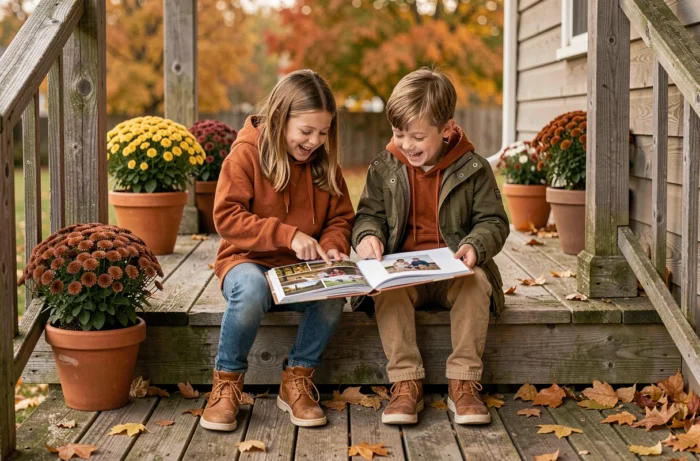
A family photo album that mixes rituals, crossed perspectives, and physical traces is unlike any other. Its value does not lie in the number of pages or the quality of the camera used, but in the intention that guided each choice of photo, text, and layout. The most challenging part is not the technical execution; it is starting the selection. Take twenty photos, not two hundred, and build your first album around a single thread of connection.