
Which skincare gestures withstand analysis when comparing their actual effect on the skin, hair, or makeup? Between minimalist beauty routines and ten-step protocols, the differences in results are less about the number of products than about the relevance of each gesture in relation to skin type and recent regulatory constraints.
UV Filters and European Regulation: What’s Changing in Your Beauty Routine
Most beauty guides recommend applying sunscreen every morning. Few specify that the composition of sunscreens available in Europe has recently changed, with direct consequences on product choices.
The Regulation (EU) 2024/996 has banned the chemical UV filter 4-Methylbenzylidene Camphor (4-MBC) in European cosmetics due to concerns about endocrine-disrupting effects on the thyroid and estrogen systems. Products containing this filter can no longer be marketed in the EU as of May 1, 2025, and existing stocks can no longer be sold as of May 1, 2026.
To adapt your daily routine, check the INCI list of your sunscreens and foundations that include SPF. If the mention “4-Methylbenzylidene Camphor” appears, the product is no longer compliant. Replacement formulations favor mineral filters or new-generation organic filters whose toxicological profile has been reassessed.
At the same time, the European Union has launched a monitoring program for sunscreen products to verify the actual compliance of the displayed SPF and UVA claims. Specifically, several beauty tips shared on the Chroniques Blondes beauty site help to better decipher labels and identify reliable formulas for daily use.
Morning and Evening Facial Care: Comparison Table of Gestures by Skin Type
Not all skin types react the same way to the same gestures. An overly aggressive cleanse on dry skin accelerates dehydration, while a rich serum on oily skin can worsen excess sebum. The table below compares gestures suitable for three common profiles.
| Gesture | Dry Skin | Combination to Oily Skin | Sensitive Skin |
|---|---|---|---|
| Morning Cleansing | Milk or cleansing oil | Gentle foaming gel | Micellar water, no rinse |
| Morning Hydration | Rich cream + oily serum | Light non-comedogenic fluid | Fragrance-free soothing cream |
| Sunscreen | SPF integrated into day cream | Matifying SPF fluid | Mineral filter (titanium dioxide, zinc oxide) |
| Evening Cleansing | Double cleanse oil + milk | Foaming cleanser + purifying lotion | Single micellar milk |
| Targeted Evening Care | Nourishing mask (2 times/week) | Salicylic acid serum (T-zone) | Centella repairing serum |
The main difference lies in cleansing. Cleaning adapted to skin type conditions the effectiveness of all subsequent treatments. Applying a performance serum on poorly cleansed skin significantly reduces its penetration.
Makeup and Foundation Technique: Where the Daily Difference Lies
Foundation makeup accounts for the majority of routine errors. Applying foundation directly on dry skin or without a base creates a patchy effect within hours. In contrast, properly hydrated skin retains pigment evenly.
Three technical parameters determine makeup longevity:
- The foundation base must match the texture of the foundation: a silicone base under a water-based foundation causes a pilling effect, and vice versa
- The choice of application tool (wet sponge, flat brush, fingers) notably alters the final coverage of the same product
- Setting with loose powder works on combination to oily skin but accentuates fine lines on dry skin, where an alcohol-free setting spray is preferable
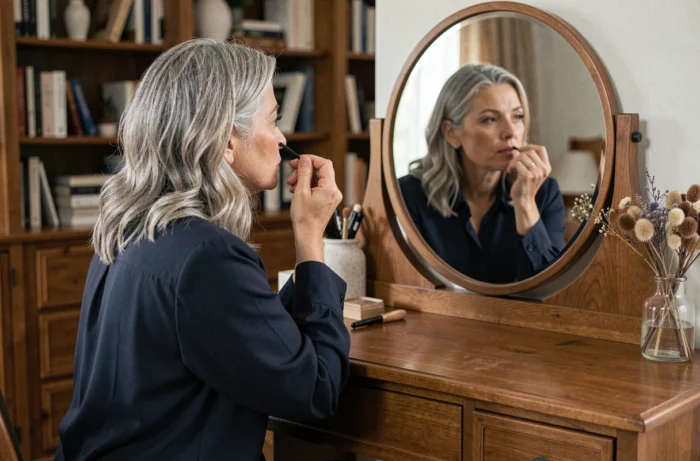
For the lips, the “full lip liner” technique (tracing the outline then filling the entire surface before applying lipstick) extends wear for several hours compared to direct application.
Quick Makeup Tips for a Polished Look
A concealer applied in an inverted triangle under the eye, blended with a damp sponge, replaces full foundation when time is short. This technique covers dark circles and evens out the look without weighing down the rest of the face.
A cream blush tapped onto the cheeks and blended towards the temples gives a healthy glow in seconds. Cream textures blend better on bare skin than powders, simplifying the morning routine.

Hair and Scalp: Often Neglected Gestures in a Beauty Routine
Hair care remains the neglected aspect of beauty routines, while the scalp functions like facial skin: it produces sebum, reacts to aggressions, and requires appropriate cleansing.
A clarifying shampoo used once or twice a month removes residues from styling products and silicones that suffocate the scalp. The accumulation of hair residues reduces volume and dulls the fiber. This simple gesture restores shine without resorting to additional treatments.
Conditioner is applied to lengths and ends, never on the roots. On fine hair, a leave-in spray treatment effectively replaces traditional conditioner, which can weigh down the hair.
Manicure and Hand Care Daily
Hands endure more aggressions than the face (repeated washing, exposure to detergents) but rarely receive daily care. Applying a hand cream containing urea after each wash maintains the skin barrier. For manicures, pushing back cuticles after a shower (when they are softened) avoids cutting them, preventing infections.
Choosing a “base + color + top coat” nail polish in three thin layers rather than two thick layers prolongs wear and limits chipping. Thin layers dry faster and adhere better to the nail.
The quality of a beauty routine is not measured by the number of products lined up on the shelf. It is measured by the coherence between skin type, formula composition, and application technique. With the tightening of European regulations on UV filters, reading labels becomes a beauty gesture in its own right.