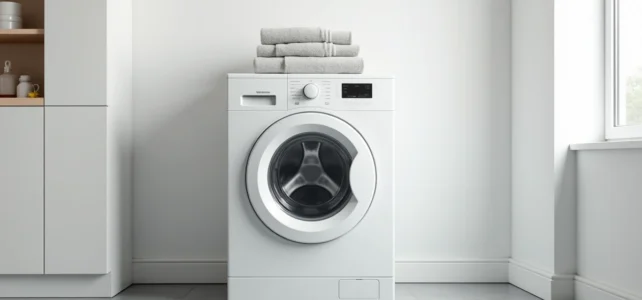
When looking for a budget washing machine, the Valberg brand often appears in the results from Electro Dépôt. The displayed prices, generally ranging from 239 to 329 euros, catch the eye. The question that arises is simple: does this price reflect good value for money, or is it a sign of a lifespan too short for the initial savings to hold up over time?
Valberg and the private label logic: what it changes in daily life
Valberg is not a manufacturer in the traditional sense. It is a private label brand (MDD) associated with Electro Dépôt, which explains the near-total absence of this brand outside of this store. In practice, the machines are produced by subcontractors whose production lines change according to the series.
This business model has a direct consequence: spare parts are not always easy to find outside the Electro Dépôt network. If the drum bearing fails after three years, one might find themselves waiting several weeks for a specific part, whereas a Bosch or Whirlpool has much more extensive networks of authorized repairers.
For someone renting a furnished studio or equipping a student housing, this operation goes unnoticed. For a family household that runs the machine five to seven times a week, the availability of spare parts becomes a criterion not to be overlooked. Here we have our review of Valberg washing machines summarized in one line: good entry price, uncertain durability.
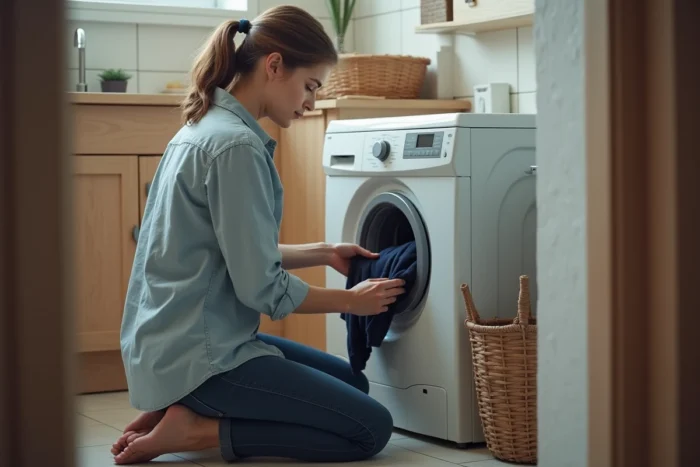
Spin, programs, and noise level: the actual performance of Valberg models
On paper, Valberg washing machines offer the expected functions at this price: delayed start, quick cycle, several wash temperatures. User feedback converges on one specific point: the short programs wash lightly soiled laundry correctly, but intensive cotton cycles extend the duration well beyond what is found with competitors at the same price.
The noise level during spinning is the most frequent complaint. Several users report marked vibrations at maximum speed, especially when the machine is not perfectly leveled. Feedback varies on this point, as the installation (flat floor, well-adjusted feet) plays a significant role. On old tiles or wooden floors, vibrations are noticeably amplified.
Drum capacity and suitable uses
Valberg models generally hover around 7 to 8 kg of capacity. For a couple or a single person, this is more than sufficient. For a family with children, one quickly reaches the limits: an 8 kg drum loaded to the maximum on an entry-level device accelerates the wear of bearings and shock absorbers.
- Solo use or couple without children: the capacity and programs cover standard needs without straining the machine
- Student shared housing or temporary furnished accommodation: the price/function ratio is optimal over two to three years of use
- Family with large daily laundry: intensive use exposes to faster mechanical failures than with a premium brand
Valberg lifespan compared to major brands: the real calculation
The average lifespan of Valberg devices (across all categories) is generally in the range of five to seven years, according to aggregated consumer feedback. Major brands like Bosch or Miele typically last between eight and twelve years.
Translated into usage cost, the gap is less than one might think. A Valberg washing machine at 270 euros replaced after five years costs about 54 euros per year. A Bosch model at 500 euros that lasts ten years costs 50 euros per year. The initial extra cost of a more robust brand pays off over time, not to mention the delivery and old appliance pickup fees with each replacement.
When Valberg remains relevant nonetheless
The calculation changes if one does not plan to keep the appliance for long. A landlord equipping a furnished rental, a student settling in for two or three years, someone reselling second-hand after a move: in these cases, a Valberg appliance fulfills its role without straining the budget.
On the other hand, buying a Valberg as the main machine in a household of four with the intention of keeping it for ten years is a risky bet. The savings made at purchase may disappear in early replacement costs.
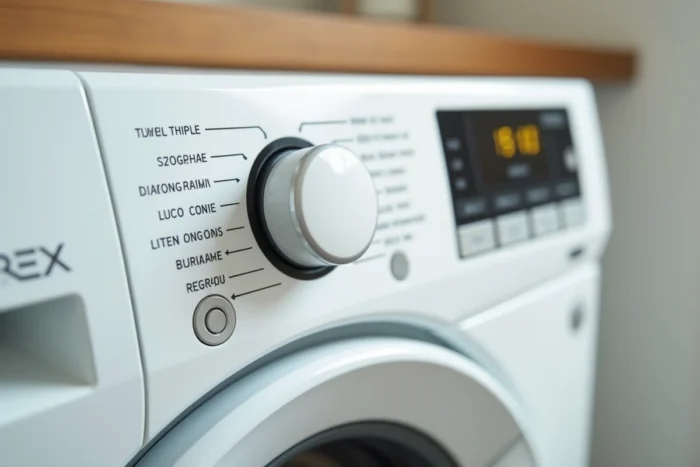
Valberg pictograms and manual: frequent mistakes that cost dearly
A recurring problem in forums is the reading of pictograms on the control panel. The spin logo, in particular, is confusing on several Valberg models. Users often initiate maximum spin on delicate laundry, which damages the clothes and unnecessarily strains the mechanics.
- The spiral pictogram corresponds to spinning, but its position varies by model, sometimes next to rinsing
- The temperature symbol is sometimes confused with the program selector, leading to washing at 60 °C delicate items that cannot withstand it
- The paper manual provided is often brief: consulting the PDF version on the Electro Dépôt website provides more details on each cycle
Taking ten minutes to go through the complete manual before the first use avoids most of the errors reported by users. This is not a design flaw per se, but a lack of clarity in the interface that particularly penalizes first-time buyers.
The Valberg washing machine occupies a specific place in the market: that of a functional entry-level price, suitable for moderate or temporary use. For a household planning to keep their machine for more than five years with a high washing frequency, brands with longer lifespans remain a better investment in terms of actual annual cost.