Neutral food alcohol with an alcohol content of around 90 degrees is not found in the same place depending on the visited Leclerc store. The confusion with household alcohol remains the primary trap, and the scarcity of the product in self-service complicates the search even further. Here, we detail the technical points to master in order to locate, identify, and purchase the right bottle.
Computer classification at Leclerc: why the Drive search engine does not return the right alcohol
Since 2025, several Leclerc stores have reconfigured their internal product databases. Price tags and scan-purchase tools now filter results so that household alcohol references no longer appear in queries for “fruits,” “liqueur,” or “maceration”. The stated goal is to limit confusion and the misuse of a household product for food purposes.
In practice, this separation works in one direction but not the other. Food alcohol at 90 degrees, when it exists in the catalog, is classified under “liquids – alcohol – spirits.” Typing “alcohol 90” in the Drive search bar may only return the household bottle, classified under “household – maintenance,” because it has a more generic label.
We recommend searching directly by the spirits category in Drive rather than by keywords. If the food reference exists in the store, it will appear in this hierarchy. If not, its absence confirms that the point of sale does not offer it.
To delve deeper into the regulatory aspects and available formats, a comprehensive guide addresses food alcohol 90 for fruits at Leclerc with details on the legal mentions to check.
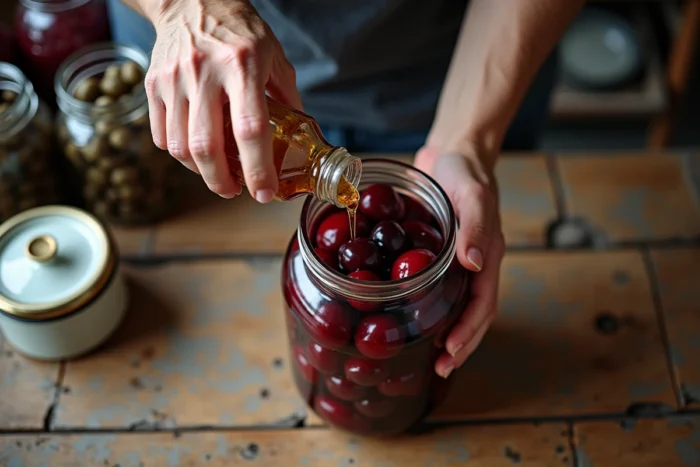
“Food” mention on the label: technical reading of the bottle
The alcohol degree alone guarantees nothing. A bottle of 90-degree household alcohol sold in the household section contains denaturants (bitrex, methyl ethyl ketone, or similar) that make it unsuitable for consumption. Only the mention “food alcohol” or “for liqueur preparation” allows for oral use.
Three elements must appear on the label of a neutral alcohol intended for fruit maceration:
- The explicit mention “food alcohol,” “oral alcohol,” or “for liqueurs and fruits in brandy,” which distinguishes the product from technical alcohol
- The actual volumetric degree (often between 85 and 90 degrees for supermarket references), printed on the front
- The absence of any denaturing agent in the ingredient list, which normally limits itself to “agricultural origin ethyl alcohol” and “water”
When the bottle only bears the mention “burning alcohol” or “modified alcohol,” it is a household product, regardless of the displayed degree. We observe that confusion persists because both types of bottles sometimes share very similar packaging.
Leclerc wine and spirits aisle: the underutilized avenue for maceration alcohol
The trend in large retail is to replace neutral alcohol with ready-to-consume spirits: vodkas, white rums, fruit brandies with an alcohol content between 37.5 and 55 degrees. These references occupy shelf space and marginalize high-concentration neutral alcohol.
However, the wine cellar managers of some Leclerc stores still keep the reference, but it is placed at the bottom of the shelf or behind the spirits counter, out of the usual customer path. Asking the staff in the wine cellar directly remains the most reliable method to find out if the product is available.
The classification in the spirits aisle also means that the product is subject to the same sales restrictions as any oral alcohol: prohibition of sale to minors, no promotional highlighting in certain store configurations.
Difference in degree and impact on maceration
An alcohol with an alcohol content of 40 to 45 degrees does not produce the same result as 90-degree alcohol on a fruit maceration. The higher the degree, the faster and more stable the extraction of flavors and preservation. With 40-degree alcohol, the maceration time must be significantly extended, and the risk of unwanted fermentation increases if the fruit/alcohol ratio is poorly calibrated.
Using vodka or white rum as a substitute also alters the flavor profile. 90-degree neutral alcohol adds no inherent flavor, allowing the fruit to express itself fully. A flavored spirit overlays its own taste signature onto that of the fruit.
Online purchase of neutral food alcohol: checks before ordering
Several specialized websites for liquor supplies offer high-concentration neutral food alcohol. Before ordering, we recommend checking the following points:
- The seller must hold a remote alcohol sales license, mentioned in the general terms of sale or legal mentions of the site
- The product must clearly display its agricultural origin and degree, with the mention “agricultural origin ethyl alcohol” without denaturant
- Delivery costs for a flammable product classified as hazardous may be significantly higher than standard delivery, which changes the actual cost per liter
The price per liter online often exceeds that practiced in physical stores, but availability is more consistent. For liqueur makers who macerate several kilos of fruit per season, ordering online helps avoid back-and-forth trips between stores.
Concrete alternatives when 90-degree alcohol remains unavailable
If no nearby Leclerc offers the 90-degree food reference, two options are worth exploring before resorting to a classic spirit.
Wholesalers supplying distillers and liquor makers sell neutral alcohol in larger containers. The price per liter is generally more competitive, but the minimum purchase can reach several liters.
Some wine cooperatives and local distilleries market marc or lees brandy with an alcohol content between 60 and 70 degrees. This is not neutral alcohol, but the degree remains sufficient for effective maceration, with a flavor profile that can enrich the preparation rather than neutralize it.
The scarcity of 90-degree neutral alcohol in supermarkets is not a phenomenon unique to Leclerc. It reflects a commercial repositioning of the entire distribution towards finished products with higher margins. For enthusiasts of fruits in brandy, anticipating purchases at the beginning of the season and diversifying supply sources remains the safest strategy.