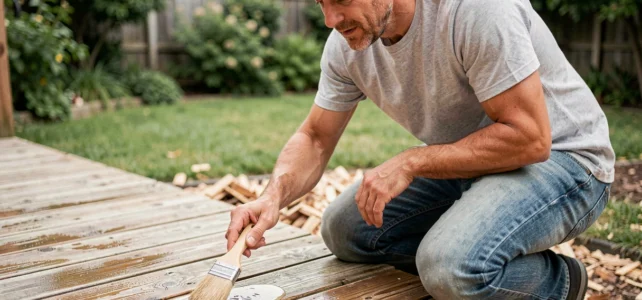
The Parkside wood protection gel, distributed through the Lidl network, catches attention with its aggressive pricing compared to specialized brands. The question that deserves to be asked: does this type of product offer protection comparable to the stains and gels sold in DIY stores, or do the formulation differences show over time?
Parkside wood protection gel versus specialized stains: what the formulations reveal
Not all wood protection gels and stains are equal in terms of chemistry. Specialized brands (Sikkens, V33, Sadolin) have gradually shifted towards water-based or hybrid systems to reduce volatile organic compounds (VOCs), in line with recent European guidelines on paints and varnishes.
The Parkside gel fits into this trend, but its positioning as a private label involves formulation compromises. Mass-market products tend to simplify the composition to maintain a low price, which can result in a lower concentration of protective resins or UV blockers.
| Criterion | Parkside Gel (private label) | Specialized Stains (V33, Sikkens, Sadolin) |
|---|---|---|
| Base | Water-based | Water-based or hybrid depending on the range |
| VOCs content | Reduced (regulatory compliance) | Reduced, with optimized formulations |
| UV protection | Basic | Enhanced UV filters on outdoor ranges |
| Recommended number of coats | Two to three coats | Generally two coats |
| Estimated outdoor durability | Frequent renewal | Longer lasting before maintenance |
To complement this analysis, a review of the Parkside wood protection gel details user feedback on the polyurethane stain of the same brand, with similar observations on longevity.
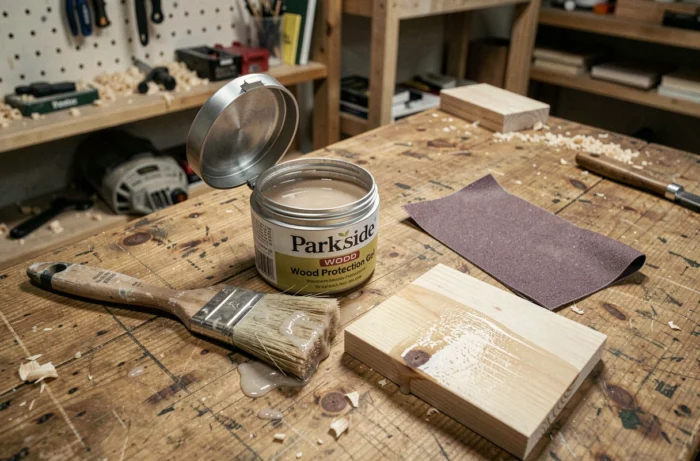
Application conditions for wood gel: parameters that instructions downplay
The shift to water-based formulations, accelerated in recent years under regulatory pressure, has a direct consequence on application: increased sensitivity to temperature and humidity. This point is rarely detailed in consumer instructions, including those from Parkside.
A water-based gel applied in humid weather or below a certain temperature dries poorly, compromising adhesion and protection. Specialized manufacturers generally specify temperature and relative humidity ranges in their technical data sheets. Private label brands often settle for a pictogram stating “do not apply in the rain.”
Surface preparation before application
The quality of the finish depends as much on preparation as on the product itself. Insufficient sanding or still damp wood negates the benefits of any gel, Parkside or otherwise.
- Sand the wood along the grain with medium grit, then finish with fine grit to achieve a uniform and open surface that absorbs the product properly
- Ensure that the wood’s moisture content remains low: waterlogged wood prevents gel penetration and causes blistering during drying
- Thoroughly dust off after sanding, as residues create irregularities under the gel layer
- On previously treated wood, strip the old finish down to bare wood to ensure proper adhesion of the new coat
These preparation steps are the same regardless of the product. However, an entry-level gel is less forgiving of approximations than a high-end stain whose formulation partially compensates for substrate defects.
Drying and layering: where Parkside gel shows its limits
The drying time between coats determines the final durability of the treatment. Water-based gels like Parkside dry quickly on the surface, giving a false impression of complete hardening. Applying the second coat too early traps moisture between the two films and weakens the overall structure.
Specialized stains often incorporate coalescing agents that slightly slow down surface drying, allowing time for the film to form correctly at depth. This type of additive comes at a cost, which partly explains the price gap with private label products.
Application technique for an even finish
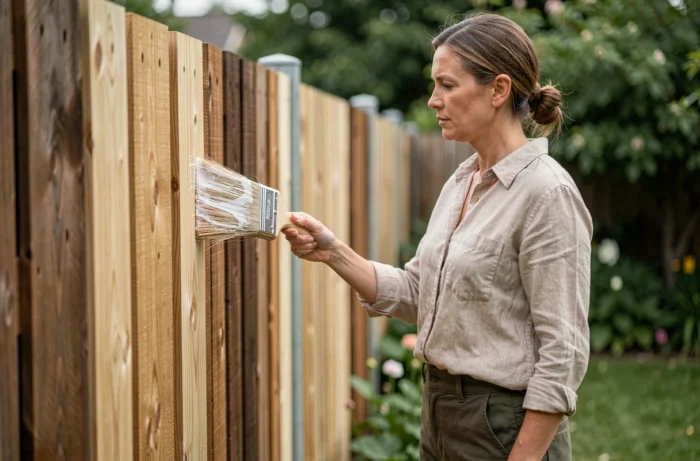
The gel is applied with a wide brush or flat brush, in thin and even layers. A common mistake is to overload the tool to reduce the number of passes.
- Apply in the direction of the wood grain, without going back over an area that is starting to dry
- Respect the complete drying time between each coat, even if the surface feels dry to the touch
- Work in logical sections (a deck board, a shutter panel) to avoid lap marks
On exposed outdoor surfaces, three thin coats are better than two thick coats. This rule applies to all gels and stains, but it becomes particularly crucial with a product whose concentration of protective resins remains modest.
Biocide regulation and wood protection gel: an underestimated selection criterion
Gels and stains containing fungicides or insecticides are regulated by Regulation (EU) No 528/2012 on biocidal products. Recent updates from the European Chemicals Agency (ECHA) have tightened the rules on classification, labeling, and usage restrictions for the general public.
A “basic” protection gel without biocidal agents protects against water and UV, but does not prevent mold or attacks from wood-destroying insects. For outdoor wood in contact with moisture (decking, cladding, fencing), this distinction is crucial. Checking for the presence or absence of biocide mentions on the Parkside gel label allows you to know if the product provides real fungicidal protection or merely aesthetic benefits.
Specialized brands generally display this information in detail in their technical data sheets. On mass-market products, labeling often meets only the minimum regulatory requirements, complicating comparison for an uninformed buyer.
The Parkside wood protection gel fulfills its role for routine maintenance on furniture or less exposed surfaces. For outdoor structures subjected to the elements, the formulation differences with specialized stains result in more frequent maintenance and limited biological protection.
Reading the label, respecting drying conditions, and not skimping on surface preparation remain the three factors that determine the longevity of the treatment, regardless of the product chosen.